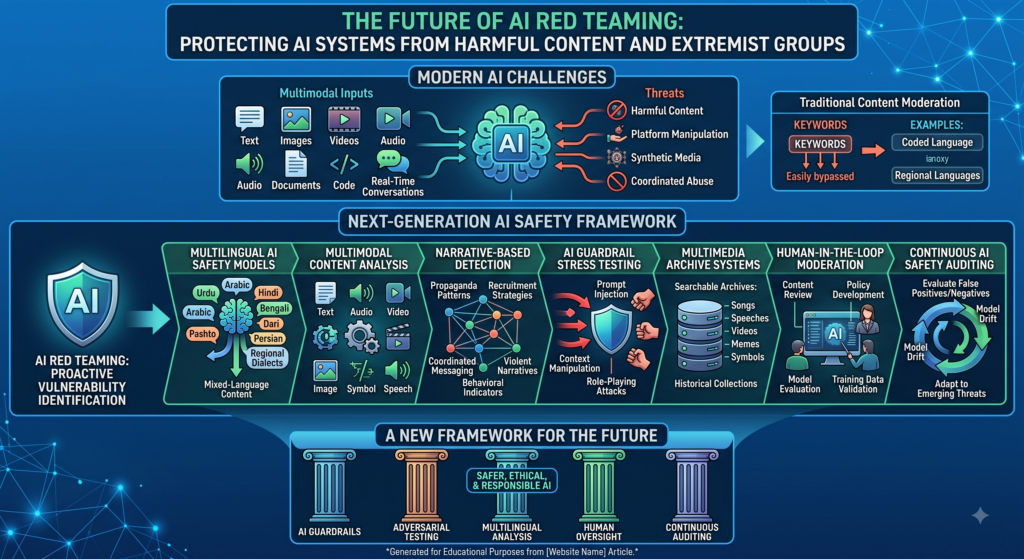
Artificial intelligence is transforming the way people search, communicate, learn, create, and share information. As AI systems become more powerful, they also face new challenges related to harmful content, platform manipulation, synthetic media, and coordinated abuse.
Traditional content moderation was designed for text-based platforms. Modern AI systems, however, must process text, images, videos, audio, documents, code, and real-time conversations simultaneously. This creates new risks that require new defensive strategies.
AI red teaming has become one of the most effective methods for identifying weaknesses in AI systems before they can be exploited. By simulating real-world misuse scenarios, organizations can evaluate how AI models respond to harmful content and strengthen their safety mechanisms.
However, current approaches are no longer enough. The next generation of AI safety will require new methods, new technologies, and new forms of human and machine collaboration.
What Is AI Red Teaming?
AI red teaming is the process of deliberately testing an AI system to identify vulnerabilities, safety gaps, and weaknesses.
The goal is to answer important questions:
- Can harmful content bypass AI safeguards?
- Can users manipulate the AI through prompt engineering?
- Can multilingual content avoid detection?
- Can harmful narratives be hidden in audio, images, or videos?
- Can AI-generated content spread across multiple platforms without being identified?
Red teaming helps organizations identify these weaknesses before they become large-scale problems.
Why Traditional Content Moderation Is No Longer Enough
Most content moderation systems focus primarily on keywords.
This approach creates several limitations:
- Harmful content can be rewritten using coded language.
- Content can be translated into regional languages.
- Images can contain hidden messages.
- Audio recordings can include symbolic language.
- Videos can combine text, speech, music, and visual elements.
- AI-generated content can change rapidly.
Because harmful actors constantly adapt their communication methods, AI safety systems must evolve continuously.
New Technologies That Should Be Developed
1. Multilingual AI Safety Models
Many moderation systems perform well in English but struggle with regional languages.
Future AI systems should be able to analyze:
- Urdu
- Arabic
- Hindi
- Bengali
- Pashto
- Dari
- Persian
- Regional dialects
- Mixed-language content
Language should no longer be a barrier to AI safety.
2. Multimodal Content Analysis
Future moderation systems should analyze multiple content formats simultaneously.
Instead of analyzing only text, AI systems should combine:
- Text analysis
- Audio analysis
- Video analysis
- Image analysis
- Symbol recognition
- Speech analysis
This approach would improve the detection of harmful narratives that move between different media formats.
3. Narrative-Based Detection
Keywords alone are no longer sufficient.
Future AI systems should focus on identifying:
- Propaganda patterns
- Recruitment strategies
- Coordinated messaging
- Violent narratives
- Behavioral indicators
Understanding the meaning behind content is often more important than detecting individual words.
4. AI Guardrail Stress Testing
Organizations should move beyond simple moderation testing.
Future red teams should evaluate:
- Prompt manipulation
- Instruction bypass attempts
- Prompt injection
- Context manipulation
- Role-playing attacks
- Multilingual prompt attacks
Continuous stress testing will become an essential part of AI development.
5. Multimedia Archive Systems
Many harmful narratives are distributed through songs, speeches, videos, memes, symbols, and historical publications.
Future AI systems should include searchable archives containing:
- Audio samples
- Visual references
- Multimedia datasets
- Historical content collections
- Annotated training materials
Structured archives can improve model training and support more accurate content recognition.
6. Human-in-the-Loop Moderation
AI should not make every moderation decision independently.
Human experts should remain involved in:
- Content review
- Policy development
- Model evaluation
- Risk assessment
- Training data validation
Combining human expertise with AI systems creates stronger and more reliable moderation processes.
7. Continuous AI Safety Auditing
AI safety should not be treated as a one-time project.
Organizations should continuously evaluate:
- False positives
- False negatives
- Model drift
- Language performance
- Safety vulnerabilities
- Guardrail effectiveness
Continuous auditing allows organizations to adapt to emerging threats and improve AI performance over time.
A New Framework for the Future
The next generation of AI safety should combine five key elements:
- AI guardrails
- Adversarial testing
- Multilingual analysis
- Human oversight
- Continuous safety auditing
These five components can create a stronger defense against harmful content and improve the resilience of AI systems.
Conclusion
AI is changing the digital world at an unprecedented speed. At the same time, organizations must ensure that these technologies remain safe, ethical, and responsible.
The future of AI safety will depend on stronger guardrails, better red teaming practices, multilingual capabilities, and more advanced multimedia analysis.
Building safer AI is not only a technical challenge. It is a long-term commitment that requires collaboration between researchers, technology companies, policymakers, trust and safety professionals, and AI developers working together to create a more secure digital ecosystem.